- Cavea GmbH
- RTLS vs RFID
RTLS vs RFID: Key Differences, Costs and When to Use Each
Both track assets, but they solve different problems. Here is how to choose.
- 6 Min. reading time
- Updated August 2026
- Pillar Guide
Content
RFID and a real-time locating system are often compared as if they were alternatives. In practice they show major differences: one records identity at a fixed place, the other reports position across a whole area. This guide sets out the differences in accuracy, infrastructure, cost and fit, so you can decide which one your operation actually needs.
-
Key Points at a Glance
- RFID identifies an item when it is in reach of a reader. RTLS continuously shows where an item is in real time.
- RFID tags are usually far cheaper than RTLS tags. When it comes to the infrastructure it depends on the setup and selected technology.
- Choose RFID for check-in and check-out and for inventory. Choose RTLS for continuous location, zones and safety.
RFID and RTLS Side by Side
Ten criteria that decide most projects. Read the row that matters most for your operation first.
| Criterion | RFID passive and active | RTLS real-time locating system |
|---|---|---|
| What it tells you | Presence or ID at a fixed read point. | Continuous real-time position. |
| Typical accuracy | Zone or gate level. Presence only. | 10 to 30 cm with UWB. Sub-meter to a few meters with BLE AoA. |
| Update frequency | An event when a tag passes a reader. | Can be defined to match the need. From minutes to milliseconds. |
| Range | Passiv: Depending on the frequency a few centimeters (LF/HF) and up to about 10 meters (UHF). Active: More than 10 meters. | The full covered area, via a grid of anchors. |
| Infrastructure | Readers and antennas at defined choke points. | A grid of anchors and gateways across the area. |
| Tag power | Passive tags need no battery. Active tags run on a battery. | Battery-powered. The battery life depends on the transmission interval, ranging from months with frequent updates to several years with infrequent transmissions. |
| Data richness | Scan events. | Continuous track, dwell time, zones, movement analytics. |
| Cost per tag | The clearest cost advantage. A passive RFID tag typically costs less than a tracking tag. | Higher than RFID, because the tag carries electronics and a battery. The range is wide by technology. |
| Infrastructure cost | Depends heavily on the setup. Handheld scanners are cheap; fixed gates, with antennas, cabling and installation, sit at the top end. | Depends on the technology. UWB needs a denser and costlier anchor grid; e.g. Mesh solutions can be installed without cabling at lower costs. |
| Best fit | Inventory, access, check-in and check-out, item presence. | Live asset location, work-in-progress tracking, safety zones, process optimization. |
How Each Technology Works
How RFID Works
A reader sends out a radio field. When a tag enters that field, a passive tag draws its power from the field and sends back its ID; an active tag transmits on its own battery. The system logs one event: this tag was seen by this reader at this time. Between read points there is no data, so the picture is a chain of confirmations rather than a location.
How RTLS Works
Tags communicate continuously with a grid of anchors installed across the area. The system measures signal timing or angle at several anchors and calculates a position from those measurements. The position updates in seconds or faster, so movement, dwell time and zone entries are recorded as they happen. Coverage is defined by the anchor grid, not by a gate.
Which One Do You Need?
RFID: one read point
One event, at one place, at one moment.
RTLS: a grid of anchors
A continuous position.
-
RFID is enough when
- You only need to know an item passed a point.
- You track inventory in and out.
- You label very large numbers of items and tag cost decides the case.
- You do not need live position.
-
You need RTLS when
- You need continuous real-time location.
- You manage zones or safety areas.
- You want dwell time and process analytics.
- You track high-value or fast-moving assets.
The third option
You Don’t Have to Choose: RFID and RTLS in One Tag
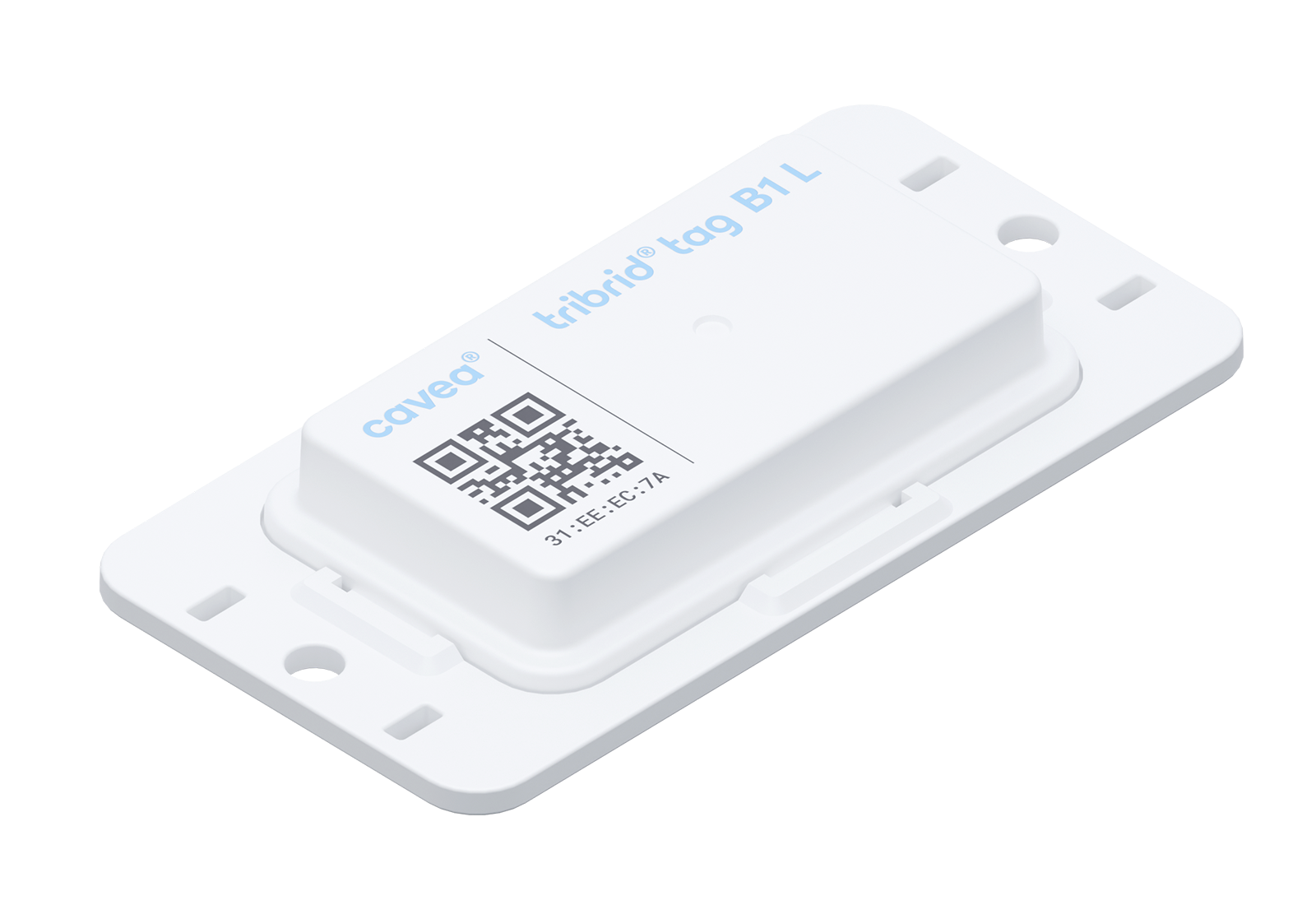
The RFID-or-RTLS decision doesn’t necessarily mean you have to pick one. With the right hardware, you don’t. Cavea’s Tribrid® Tag B1 combines several RTLS technologies and RFID in a single device.
AoA
Cavea Mesh
BLE
RFID
The Tribrid® Tag B1 carries Angle of Arrival (AoA), Bluetooth Low Energy (BLE), Cavea Mesh and RFID in one device. Use RFID at the gate for check-in and check-out, and RTLS inside the area for continuous real-time location, all from the same tag. One hardware standard, both worlds, no second tag system to deploy and maintain.
Both in one device: continuous real-time location and RFID identification, no dual hardware.
Flexible per use case: select or combine technologies without swapping tags.
Future-proof: start with RFID today and add full RTLS later on the same tag.
Frequently Asked Questions
Is RTLS better than RFID?
Neither is better. They answer different questions. RFID confirms that an item passed a point. RTLS shows where the item is right now.
Can RFID do real-time tracking?
Not continuously. RFID reads at fixed points, so you get events, not a live position between readers.
Is RTLS more expensive than RFID?
Not as a general rule. The one clear point is that an RFID tag is normally cheaper than a tracking tag. Infrastructure depends on the setup. RFID with handheld scanners is inexpensive, while fixed RFID gates are among the costlier builds. On the RTLS side, UWB sits well above a mesh network. Always compare per use case and over total cost of ownership.
Which technology does RTLS use?
Commonly UWB, BLE AoA and mesh approaches such as Cavea Mesh, chosen by accuracy, range, battery life and total cost of ownership.
Which RTLS is right for your use case?
Book a no-obligation consultation.
What is RTLS?
The definition, the core components and how a locating system is deployed.
RTLS glossary
UWB, AoA, anchors, tags and omlox explained in plain terms.
Asset tracking blog
Deployment notes and results from production, logistics and healthcare.

