- Cavea GmbH
- What is RTLS? Real-Time Locating Systems Explained | Cavea
What is RTLS? Real-time
locating systems explained simply.
A comprehensive overview of real-time location systems: technologies,
how they work, applications, ROI, and what to consider when choosing one.
- 8 min. reading time
- Updated June 2026
- Pillar Guide
Content
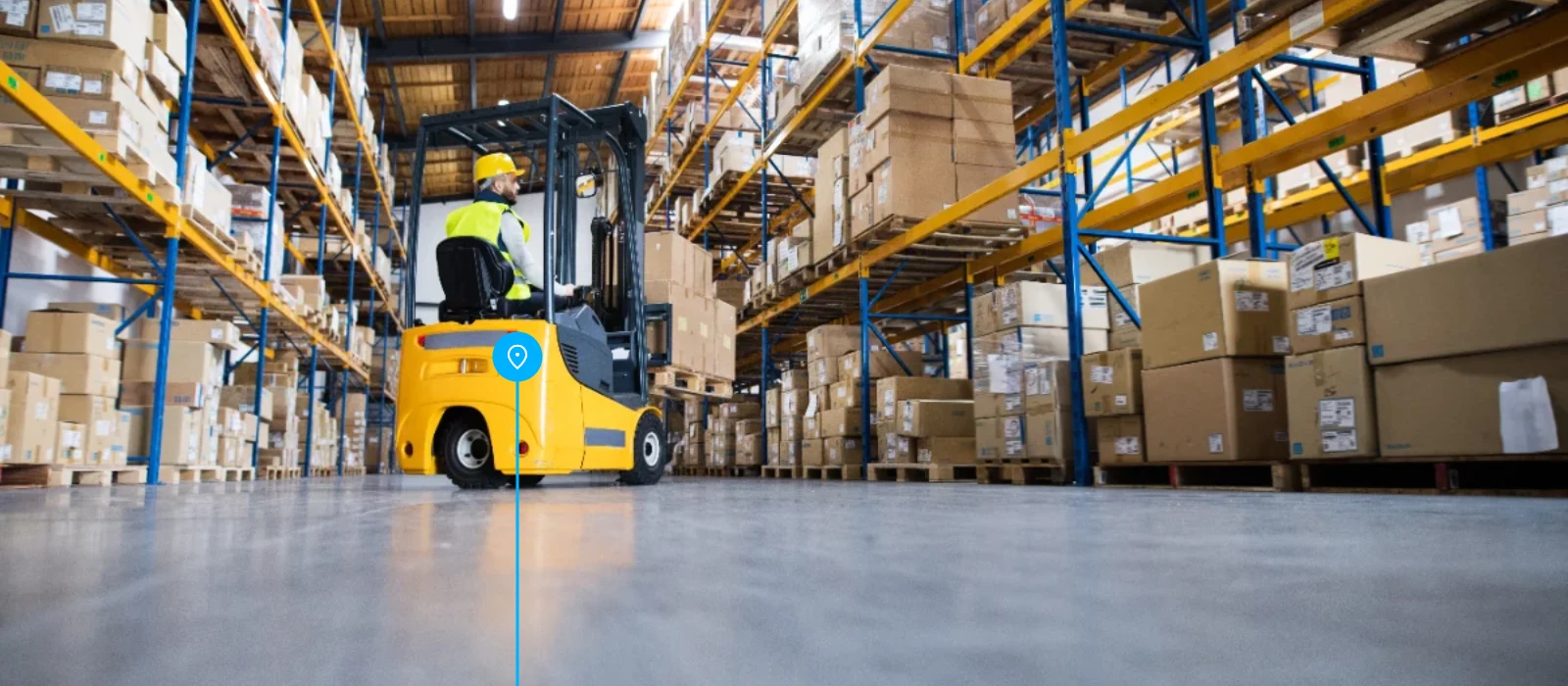
Where is that forklift, tool, container or medical device right now? Answering this in real time creates transparency, cuts search time, automates processes and builds the data foundation for digital twins and AI-driven automation. That is exactly what an RTLS delivers. This guide explains what RTLS means, the technologies behind it, where it is used and what matters when you choose a system.
RTLS meaning, in plain terms
RTLS stands for Real-Time Locating System. An RTLS locates and tracks objects or people within a defined area, such as a production hall, a warehouse or a hospital, continuously and in real time. Unlike barcode or RFID scans that only capture a status at a single reader, an RTLS provides a continuous position without anyone having to scan actively.
Where is it now?
Where was it before?
How is it moving?
This data is used to develop applications ranging from simple asset searches to fully automated process control.
How does an RTLS work?
An RTLS typically consists of several components. Tags attached to objects transmit radio signals, anchors receive them, gateways relay the location data, and when using the system, customers can choose between options such as ERP integration and a dedicated RTLS application.
Position determination: depending on the technology, e.g., via time-of-flight measurement, angle-of-arrival measurement, or signal strength (RSSI).
RTLS technologies at a glance
There isn’t just one RTLS technology; rather, there are several that differ in terms of accuracy, range, cost, and power consumption. Which one is right depends on the specific application; often, a combination of several technologies makes sense.
Angle of Arrival
Determines the position based on the angle of incidence of the radio signal and achieves a high degree of accuracy of less than one meter.
Ultra-Wideband
Highly precise positioning within a range of a few centimeters to decimeters, ideal for demanding applications.
Cavea Mesh
Scalable Mesh
Scalable mesh technology in which all components automatically form a network. Fully battery-powered (up to 10 years of battery life), no wiring required, and large-scale installations with minimal infrastructure requirements.
Bluetooth Low Energy
Cost-effective and energy-efficient, well-suited for applications with moderate accuracy requirements.
Outdoors
For outdoor positioning where no indoor infrastructure is available.
Zones & Gates
Learn more on our Technology page.
Why an open standard matters: omlox
Many RTLS solutions are vendor-locked, which makes it difficult to expand them later on. The open location standard omlox enables interoperability: tags, anchors, and software from different vendors and technologies work together. This protects investments and prevents dependence on a single vendor.
Simplified illustration based on the omlox architecture model: complementary locating zones send their positions to the omlox Hub via the standardized Hub API, which harmonizes them for all applications. Learn more on our omlox page.
Use cases: where RTLS delivers
Smart Factory
Real-time tracking of tools, containers, and material flow enables automated processes, digital value stream analysis, and eKanban.
RTLS Data: The Foundation for Automation, Digital Twins, and AI
Process Automation
Processes are triggered automatically as soon as materials, tools, or vehicles are in the correct location, such as with eKanban or automatic bookings.
Digital Twins
A digital twin of a factory, warehouse, or hospital can only make informed decisions if it knows in real time where objects and people are located.
Here you’ll find our guide on how RTLS data enables the digital twin to support decision-making.
Routes, turnaround times, bottlenecks, and capacity utilization become measurable and can thus be optimized in a targeted manner.
Autonomous mobile robots, humanoid systems, and AI agents can only act safely and effectively if they know exactly what is happening in their working environment. RTLS provides this real-time situational awareness, making it a must-have for AI-powered automation.
What is the ROI of RTLS?
The economic benefits arise in several areas: less time spent searching for items, fewer losses and stock shortages, higher equipment and labor utilization, and a foundation for process automation and data-driven decisions. In many projects, the reduction in search times alone offsets a significant portion of the investment.
However, RTLS data has the greatest impact when used as the foundation for automation and AI: By automatically triggering processes, feeding a digital twin in real time, and providing AI agents with a reliable situational overview, organizations can unlock efficiency and quality gains that would remain out of reach with manual data collection.
Battery life with Cavea Mesh
Battery life is a key TCO factor, as replacing thousands of batteries is costly. The specific impact depends on the industry, use case, and scale.
How to choose an RTLS
The key factors are the system’s precision and latency, combined with the tags’ battery life. It is crucial that they are suited to the specific use case, as this is the only way to achieve the best system and the best possible ROI.
- Precision — from zones down to the centimeter level, tailored to the task at hand.
- Latency – how quickly the position becomes available for real-time processes.
- Battery life—a key TCO factor; Cavea Mesh lasts up to 10 years.
- Scalability — across many objects and multiple locations.
- Integration capabilities — with existing IT systems such as ERP, MES, and WMS.
- Openness — using standards like omlox to avoid vendor lock-in.
Cavea offers a broad technology portfolio, including its own hardware manufactured in the EU and omlox-compliant components.
Conclusion
RTLS makes movement visible and provides the real-time data foundation needed to automate processes, feed digital twins, and enable AI-powered systems in industry, logistics, and healthcare. It is crucial to carefully align technology with use cases and to prioritize openness through standards such as omlox.
Frequently Asked Questions
What is the difference between RTLS and RFID?
RFID identifies objects at individual reading points, while RTLS continuously tracks their location throughout the entire area.
How accurate is RTLS asset tracking?
Depending on the technology, ranging from a few centimeters (UWB) to rough zone-based location tracking (BLE).
How long do the batteries last?
Battery life depends primarily on the desired update rate. With Cavea Mesh, our tracking tags can last up to 10 years, which significantly reduces operating costs.
How time-consuming is the implementation?
The effort required for implementation also depends on the technologies selected. For example, the effort involved in AoA and UWB installations, which require cabling, exceeds that of battery-powered hardware that does not require cabling. This is particularly important to consider for future scaling after an initial pilot: Is the infrastructure effort minimal, and is the solution quickly scalable?
In addition, it is, of course, important to consider which software integrations may need to be implemented.
Which RTLS is right for your use case?
Book a no-obligation consultation.

