How Asset Tracking and RTLS Technologies Optimize Processes – Learn Everything You Need to Know About RTLS Here
RTLS systems play a crucial role in the automation and optimization of processes in Industry 4.0 by enabling the precise localization of mobile assets or objects such as machines, tools, transport vehicles, containers, or industrial goods. To efficiently manage complex operations in industrial environments, it is essential to continuously monitor the location and status of relevant objects.
RTLS asset tracking refers to the tracking and management of physical resources, such as machines, tools, vehicles, or materials, within a defined area. It provides companies the ability to monitor the location, condition, and availability of assets in real-time. RTLS systems (Real-Time Location Systems) are technologies that capture real-time location data from various objects or people. These objects are typically located within a specific application area, such as industrial manufacturing or warehouses. To determine accurate data about the position of tagged objects, precise localization data is provided using sensors and a network infrastructure. This enables companies to manage their resources efficiently and optimize their processes.
In the following, we will examine what RTLS means, how these systems work, and their applications in the industry.
What does asset tracking and RTLS mean?
Asset tracking refers to the tracking and management of physical resources, such as machines, tools, vehicles, or materials, within a defined area. It provides companies the ability to monitor the location, condition, and availability of assets in real-time.
RTLS systems (Real-Time Location Systems) are technologies that capture real-time location data from various objects or people. These objects are typically located within a specific application area, such as industrial manufacturing or warehouses. To determine accurate data about the position of tagged objects, precise localization data is provided using sensors and a network infrastructure. This enables companies to manage their resources efficiently and optimize their processes.
How does RTLS tracking work?
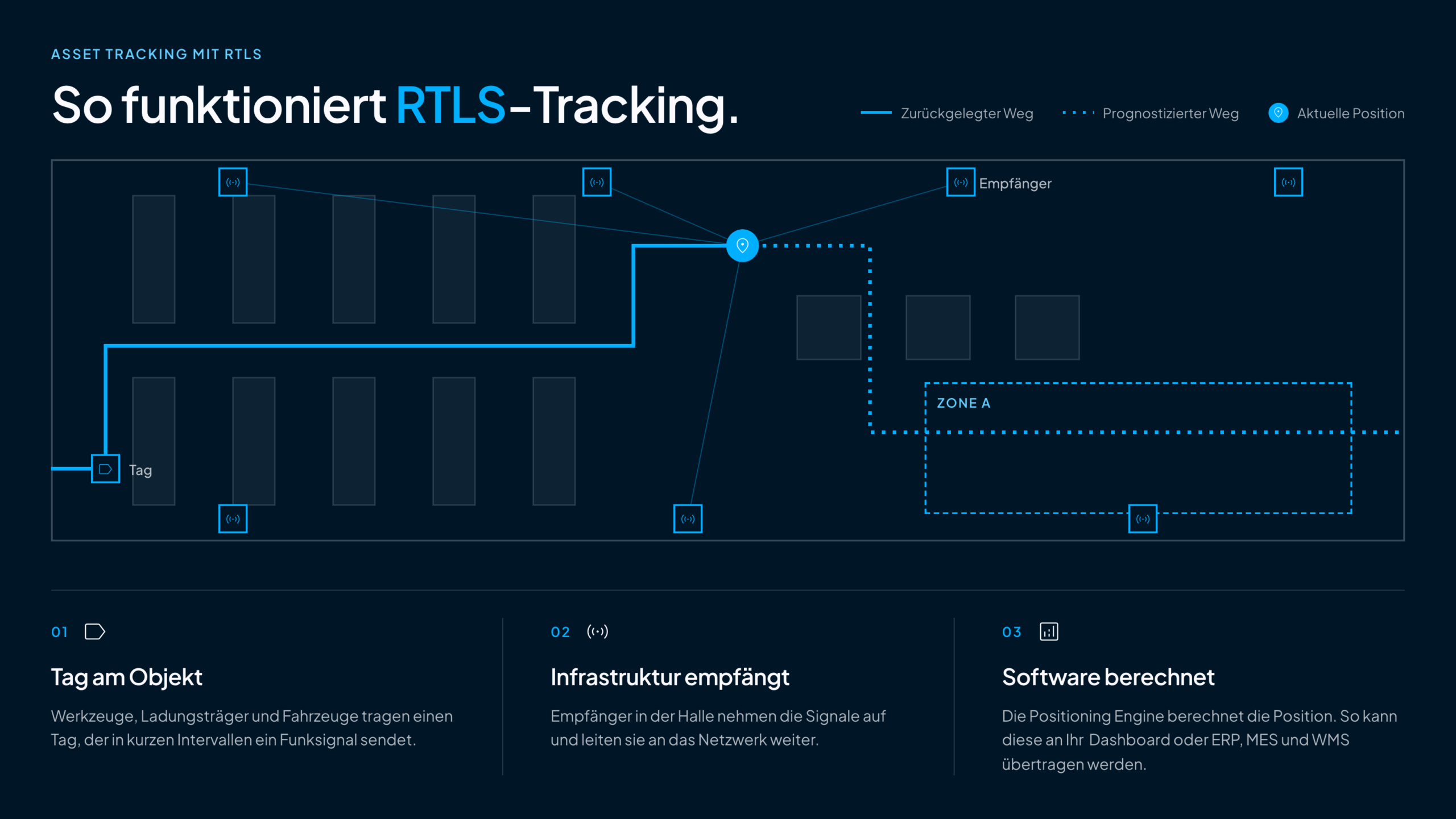
RTLS tracking uses various radio technologies such as BLE, GPS, RFID, mesh networks, or UWB to determine the precise position of tools within a specific area. These systems enable continuous monitoring and provide valuable information to efficiently manage resources.
- Tags and Sensors: Various objects are equipped with small tags that transmit signals. These tags can communicate via radio frequencies (RFID, BLE, AoA, UHF, IR, WAVE) or other standards such as Cavea Mesh or Ultra-Wideband (UWB).
- Infrastructure: The data from the tags is transmitted via a receiver, such as gateways (BLE), locators (AoA), anchors (Mesh), or satellites (UWB).
- Software platform: The transmitted data is processed and visualized in a software platform. This platform typically consists of two components: the positioning engines, which calculate the exact position and, if necessary, convert it into other coordinate systems, and the hub, which distributes the data to other systems. Through a dashboard, users gain comprehensive insights into the current position, movement history, and condition of the assets.
Comparison of the most common RTLS technologies.
In the field of asset tracking and real-time location, there are various technologies that are suitable depending on the use case and requirements in industrial environments. Here is an overview of the most common tracking technologies and their respective advantages:
GPS (Global Positioning System)
GPS is an established satellite technology primarily used in Europe for location tracking over long distances. It enables asset tracking outdoors with an accuracy of up to a few meters. GPS is particularly suitable for applications that require global coverage, such as tracking vehicle fleets or containers outdoors. GPS faces limitations in enclosed spaces and densely built areas, as buildings can block the signal. Additionally, its energy consumption is relatively high, making it less suitable for battery-powered devices.
BLE (Bluetooth Low Energy)
BLE is a widely used radio technology optimized for communication over short distances. It requires very little energy, making it ideal for battery-powered tags that need to run for long periods without maintenance. BLE is particularly well-suited for use in areas such as logistics or environments where objects are tracked within relatively confined spaces. It is easy to implement and widely available. However, BLE has a lower range and accuracy in indoor environments with partitions or shelves compared to other technologies and requires a large number of gateways. Additionally, BLE can be error-prone in many working environments, as it communicates point-to-point, leading to more data loss compared to a mesh topology that works with fewer gateways.
AOA (Angle of Arrival)
AOA is an advanced technique used in conjunction with BLE to determine the exact position of a tag by capturing the angle at which the signal is received by multiple antennas. This technology is suitable for high-precision applications where accurate localization (within one meter) is required in a limited area, such as for the precise assignment of tools to a workstation in manufacturing.
RFID (Radio Frequency Identification)
RFID (Radio Frequency Identification) is one of the oldest and most commonly used technologies for asset tracking, utilizing tags available in three variants: passive, semi-passive, and active. Passive RFID tags derive their energy from the reader’s signal and have a limited range, making them particularly suitable for tracking large quantities of objects over very short distances, such as goods on pallets or in containers. Semi-passive RFID tags have their own power source for operating internal components, but they only actively transmit data when captured by a reader, allowing them to cover greater distances than passive tags without continuously transmitting. Active RFID tags have their own power supply and continuously emit signals, making them particularly suitable for real-time tracking of moving objects. RFID is ideal for tracking infrequently moved assets or for simultaneously capturing large quantities. We look separately at the limits of RFID and when RFID makes sense instead of RTLS.
Cavea Mesh
Cavea Mesh is a flexible, wireless network designed for industrial applications that require scalable and reliable communication over long distances. Unlike traditional point-to-point systems, devices in a mesh network can connect to one another and relay data autonomously, enabling greater range and redundancy. Cavea Mesh is ideal for tracking assets in large, complex environments that require a stable and cost-effective infrastructure with few gateways.
UWB (Ultra Wide Band)
UWB is a highly precise technology primarily used for real-time asset tracking. It is characterized by high accuracy (often in the centimeter range) and very high update rates, making it particularly suitable for applications where precise positioning with low latency is required. UWB can be used in a variety of environments, from production halls to complex storage facilities.
How do RTLS systems find applications in industry?
RTLS systems offer a wide range of applications across various industrial sectors and play a key role in optimizing processes and resource management.
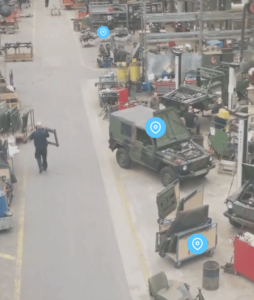
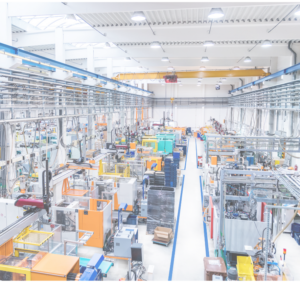
Manufacturing:In manufacturing, RTLS systems enable the precise tracking of machines and production tools, ensuring continuous material supply. Real-time localization helps make the right material available at the right time and place to avoid production interruptions. Additionally, the technology supports quality control by ensuring that materials remain at specific stations only for the intended duration. This leads to more efficient production and higher productivity.
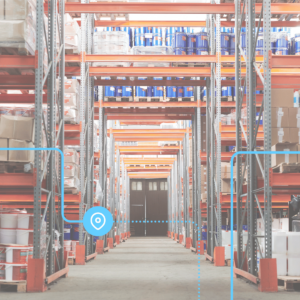
Warehouse and logistics: In warehouse and logistics applications, RTLS ensures efficient inventory management and tracking of goods movements. By integrating RTLS technologies, companies can precisely determine the location of pallets, containers, and transport vehicles at any time. The system improves inventory accuracy and optimizes material flow. Reduced search times speed up processes, minimize errors, and simplify workflows.
Healthcare:Another major potential is seen in healthcare, especially in hospitals and nursing facilities. Here, RTLS enables the precise positioning of medical devices, beds, and even patients. This helps keep valuable resources, such as medical equipment, easily locatable, manage emergencies more efficiently, and improve the quality of care.
Benefits of RTLS systems for industry:
The implementation of RTLS tracking brings numerous benefits. It helps companies increase their efficiency, optimize processes, and maintain competitiveness. Here are the key benefits at a glance:
Process optimization:The precise real-time localization of assets allows companies to adjust production schedules flexibly. This enables better utilization of equipment and a dynamic response to unforeseen events such as material shortages. The company minimizes production downtimes and boosts overall productivity.
Time savings through reduced search times: RTLS eliminates the time-consuming search for tools, machines, and materials. Production managers and employees can immediately determine the location of required assets and focus on value-adding activities.
Automated inventory management and bookings: RTLS systems capture inventory levels and material movements in real-time and transfer them directly into ERP systems like SAP. This reduces manual interventions, minimizes errors, and ensures an up-to-date inventory overview. Companies benefit from precise real-time data, which not only simplifies warehouse management but also enables informed value stream analysis and optimization.
Quality assurance and compliance: In industries with strict documentation requirements, such as the automotive or pharmaceutical industries, RTLS systems ensure seamless tracking of materials, components, and production processes. This not only simplifies compliance with regulatory requirements but also improves quality assurance.
Decision-making foundations for executives:
With the precise real-time data provided by RTLS systems, executives can make informed decisions. By analyzing movement and condition data, bottlenecks can be identified, optimization measures can be derived, and long-term strategies can be developed.

What Does an RTLS System Cost? ROI and Payback
There is no single price tag for an RTLS deployment. What you pay depends on a handful of factors, and understanding them early is the difference between a realistic budget and an unpleasant surprise halfway through the project.
What drives the cost
Required accuracy. This is the biggest lever by far. Centimetre-level UWB positioning needs a dense grid of anchors. If zone-level accuracy is sufficient, knowing that a pallet is in bay 4 rather than its exact coordinates, you need a fraction of that infrastructure. Many projects specify centimetre accuracy out of habit and end up paying for precision the use case never required. Start from the decision the data has to support, then derive the accuracy from it.
Area and building geometry. Anchor count scales with floor space, but ceiling height, racking, metal structures and fire doors matter just as much. A densely packed warehouse needs more anchors per square metre than an open assembly hall.
Number of assets. Tags are usually the smaller share of the initial investment, but they scale linearly. Above a few thousand assets, tag cost and battery replacement become the dominant line item rather than a rounding error.
Installation and infrastructure. Cabling, power, mounting and commissioning. In existing buildings this is the item most often underestimated, particularly where anchors need power in places that have never had any.
Software and integration. Licensing plus the effort to connect the system to your ERP, MES or WMS. If you want standards-based interoperability via omlox, note that the omlox hub is a licensed component, not a free add-on.
Operating cost. Battery life determines how often someone has to physically handle every tag in the building. At scale, a tag that lasts years instead of months changes the total cost of ownership more than the tag price does.
Where the return comes from
The business case rarely rests on one big saving. It usually adds up from several:
- Search time. Staff stop walking the floor looking for equipment, carriers or work in progress.
- Asset utilisation. Once you can see how often equipment is actually used, the recurring question of whether to buy more of it usually answers itself.
- Manual booking. Scanning and status updates that were done by hand happen automatically and stop being a source of errors.
- Loss and shrinkage. Assets that leave the site unnoticed become visible.
- Throughput transparency. Bottlenecks that were previously anecdotal become measurable.
A realistic view on payback
Anyone quoting a universal payback period for RTLS is guessing. The honest answer is that payback depends almost entirely on how expensive the problem is that you are solving today. A plant losing hours per shift to searching reaches break-even quickly. A pilot in a small, well-organised area may never pay for itself on its own and is better judged as groundwork for a wider rollout.
The most useful thing you can do before requesting quotes is to quantify the current cost of not knowing: how many hours per week go into searching, how often production waits for a missing carrier, how much equipment gets bought because nobody could find the existing one. That number is your benchmark, and it makes every vendor comparison concrete.
Successfully implementing Cavea RTLS systems.
Cavea offers specially developed hardware that combines various location technologies—such as Bluetooth, RFID, Angle of Arrival (AOA), and Cavea Mesh—into a single tag. This innovative integration makes it possible to tailor the use of these technologies to the specific requirements of different application areas, thereby ensuring an even better ROI.
The versatility of the tags ensures maximum scalability and makes it easy to efficiently automate a wide range of industrial environments. Whether it’s precise localization in manufacturing halls, comprehensive inventory management in warehouses, or tracking medical devices – our solution enables flexible and future-proof automation.
Another key advantage: Our hardware is fully omlox-compatible. This means it seamlessly integrates into the open, standardized infrastructure that defines the industry standard for real-time localization. Companies benefit from a forward-looking solution that is not only efficient and reliable, but also offers maximum flexibility to respond to changing requirements.
With Cavea RTLS systems, you get the ideal foundation to optimize processes, create transparency, and successfully pave the way for Industry 4.0.