How Pick by Light works and why it improves picking
Anyone who has ever stood in a supermarket and seen a light flashing at the next available checkout knows the effect of clear, visual guidance. Without thinking twice, you are intuitively guided to where you need to go—quickly, efficiently, and without mistakes. This is precisely the principle behind a proven solution in intralogistics: Pick by Light.
This is a system that controls picking in warehouses and production areas using visual signals. Instead of paper lists or mobile scanners, items are picked directly from the shelf—LEDs indicate which product needs to be picked. This saves time, reduces errors, and ensures smooth operations.
The major advantage: material flow is accelerated, sources of error are reduced, and processes can be standardized more effectively. Companies in industries with high cycle times and low error tolerances in particular rely on visual picking systems to increase their efficiency.
In this article, we take a closer look at what Pick by Light is exactly, what a typical process looks like, which industries can benefit from its use, and what advantages the method offers compared to traditional picking systems.
What is pick-by-light and how does the system work?
Pick by Light is a digital picking method in which shelf compartments or storage locations are equipped with light indicators. As soon as a picking order is received, the system activates a light signal at the corresponding picking location. Employees immediately recognize which item they need to pick—without scanning or searching manually.
The system not only displays the storage location, but often also the quantity to be removed. After picking up the product, employees confirm the pick by pressing a button directly on the compartment. The system registers the process in real time and triggers the next step.
By using illuminated indicators, companies reduce search times, avoid mistakes and increase efficiency. At the same time, training costs for new employees are reduced, as the visual guidance is self-explanatory and quickly understood. The system ensures structure and speed in the material flow, especially when order volumes are high.
How a pick-by-light process works in practice
A pick-by-light process follows a clear and repeatable sequence that can be easily integrated into everyday work. Companies rely on visual guidance to speed up material flow and efficiently guide employees through the picking process.
Typical sequence of a pick-by-light process:
- Creating Orders in the System: The warehouse management system (WMS or ERP) creates a new picking order—either automatically or manually. The order contains all relevant items.
- Signal at the storage location: As soon as the employee starts the order, the system sends a signal to the corresponding storage bins. An indicator—usually a colored LED—lights up on each bin.
- Picking Items: The employee can see at a glance which item is needed and in what quantity. The employee retrieves the product and picks the required number of units.
- Confirmation of the Pick: The pick is confirmed with the push of a button right at the bin. Alternatively, touchscreens can be used. The system registers the action in real time.
- Next Pick or Completion: Either the next bin lights up, or—in the case of a single pick—the order is complete. The system automatically reports the progress.
Special Feature: Light-guided systems can be flexibly expanded for multi-order picking or zone-based picking. Companies can dynamically adapt their processes—for example, using mobile carts with light modules or hybrid solutions combining pick-to-light and put-to-light.
The entire process saves time, reduces manual searches, and improves the traceability of individual picks. This increases transparency in the material flow and ensures stable, scalable picking performance—regardless of the order volume.
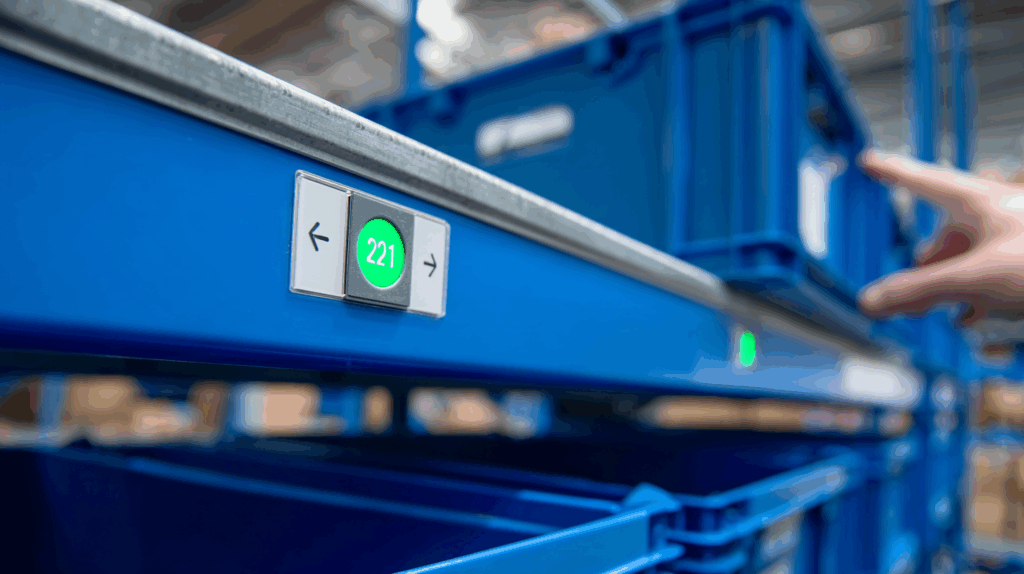 Efficient order picking through visual signals directly at the storage location
Advantages of Pick by Light in order picking
Companies use pick-by-light systems for good reason—the advantages speak for themselves. In many warehouses and production environments, this technology is replacing traditional picking methods such as paper lists or mobile scanners. The goal: faster processes, fewer errors, and a stable material flow.
Here are the key benefits at a glance:
- Lower error rate during picking
Thanks to visual guidance, employees pick items directly from the correct storage location. This reduces typical errors such as reaching into the wrong compartment or overlooking items. Pick by Light ensures accurate picking, especially when there is a wide variety of items. - Faster processes thanks to visual support
The pick-by-light display immediately shows where the next item is located – no scrolling on the scanner, no looking up on paper. This saves seconds with every pick, which quickly adds up when you have hundreds of orders a day. Picking speed increases measurably. - Improved material flow and shorter throughput times
A structured picking process has a direct impact on material flow. Goods flow faster from the warehouse to production or shipping. Companies benefit from shorter throughput times and more predictable processes—especially in tightly scheduled supply chains. - No long training period
Pick-by-light systems can be operated without extensive training. New employees immediately recognize what needs to be done. This simplifies the onboarding process and makes companies more flexible in the event of seasonal fluctuations or high turnover in the warehouse.
Scalability for growing requirements
Whether for small warehouses or large logistics centers, pick-by-light solutions can be expanded on a modular basis. Companies can adapt the system to new processes or product groups without interrupting operations.
Pick by Light offers an efficient, error-free, and scalable solution for modern picking processes. Combined with a powerful warehouse management system, the system increases productivity and ensures a smooth flow of materials—even as demands grow.
In which industries is Pick by Light used?
Pick by Light is versatile and can be used wherever companies need to pick items quickly, accurately, and at high speeds. The technology can be flexibly adapted to different industries, from e-commerce to manufacturing.
Here are some typical areas of application:
Automotive and Supplier Industry
In production, just-in-time logistics and absolute reliability are essential. Pick by Light supports the supply of materials to assembly lines by precisely indicating which parts are needed and in what order. This virtually eliminates errors in parts provision.
Logistics
A wide variety of items, small quantities, and high availability requirements—visually guided picking solutions simplify work in complex warehouse systems. Employees find the products they’re looking for faster and avoid picking the wrong items.
Pharmaceuticals and Medical Technology
This sector has strict requirements for documentation and error prevention. Digital systems with visual withdrawal indicators enable precise tracking and ensure that the correct product is dispensed in the correct quantity. At the same time, the material flow remains transparent and traceable.
E-commerce & mail order
In online retail, every minute counts: customers expect short delivery times and error-free orders. Intelligent lighting systems support the efficient picking of large quantities of items – even with frequently changing product ranges. They increase speed and accuracy, especially in multi-order picking or same-day delivery processes.
This visually assisted order-picking method is no longer a niche product. Whether you’re a manufacturing company, a logistics service provider, or an online retailer—if you want to make your processes more efficient, you’ll find a scalable and future-proof solution here.
Tip: In this use case from ekko, you’ll learn how a pick-by-light solution was implemented in practice—including a real-world example from everyday warehouse operations.
Pick-by-Light and Location Technology: A Sensible Combination?
Systems with visual picking assistance are particularly effective in stationary warehouse areas—but what happens when picking carts or entire shelving units move around the room? This is where location tracking technologies come into play.
Real-time location systems (RTLS) such as Cavea Mesh or UWB can be used to track the location of mobile objects in a warehouse. This provides companies with additional visibility into routes, locations, and process bottlenecks.
Why location tracking is a useful addition
- Real-Time Location Overview: It can quickly become difficult to keep track of mobile picking carts or containers in large logistics centers. An RTLS system such as Cavea Mesh or UWB shows exactly where each item is located—at any time and with precision.
- Automated inventory posting in the warehouse management system: When a container of goods is placed on a shelf, an RTLS system can automatically detect this, and the inventory level is updated in real time in the WMS. This eliminates the need for manual scanning and prevents posting errors.
- More Efficient Order Distribution: The combination of Pick-by-Light and RTLS enables dynamic order management—for example, through automatic assignment to the nearest team or through optimized route planning in real time.
Proven efficiency gains: A case study by Identec Solutions demonstrates that combining pick-by-light with location technologies such as RFID or RTLS can measurably increase efficiency, documenting concrete improvements such as shorter throughput times and reduced error rates.
Conclusion: Pick by Light as the key to efficient order picking
Pick by Light is one of the most effective methods for making picking processes faster, more accurate, and more transparent. Whether in e-commerce, manufacturing, or medical technology, visual guidance directly at the storage location simplifies processes and measurably increases productivity.
Even more potential is unlocked when companies combine Pick by Light with location technologies. This allows processes to be not only managed, but also analyzed, controlled, and continuously optimized.